
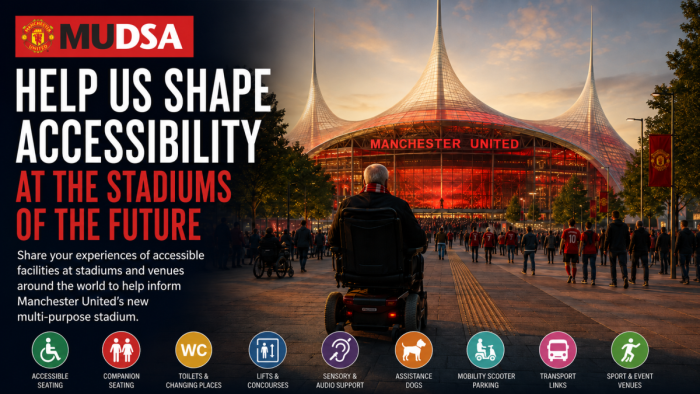
With Manchester United in the early stages of planning a new stadium, MUDSA believes this is an important opportunity to look beyond Old Trafford and learn from the experiences of disabled supporters elsewhere.
Old Trafford already offers some of the best facilities and viewing positions for disabled supporters in world sport, and there is a great deal that Manchester United already does extremely well. A new stadium, however, creates an opportunity to build on that foundation, learn from innovation elsewhere and consider ideas that may not previously have been possible.
We are running an accessibility survey to identify the facilities, ideas and approaches that are working well at stadiums and other venues — as well as those that have been tried and have perhaps not worked as intended.
The survey is open to supporters of sports clubs across the world, but our initial focus is on Everton, Manchester City and Tottenham Hotspur, as they provide some of the most modern stadium environments in the Premier League.
We want to hear from both home and away supporters who have visited these grounds and can tell us what they have experienced.
The aim is not to produce a list of complaints about other clubs. We want to identify good practice, innovative ideas and useful lessons that can help inform discussions about accessibility at Manchester United’s future stadium.
What are we looking for?
| We ARE looking for | We are NOT looking for |
|---|---|
| Innovative accessibility features or ideas | Minor matchday grumbles |
| Facilities that work particularly well | Complaints unrelated to accessibility |
| Ideas that have been tried but haven’t worked as intended | Isolated incidents with little wider relevance |
| Solutions that other stadiums could learn from | General complaints about a club or team |
| Problems caused by the design or physical fabric of a stadium | Incidental issues that aren’t really about accessibility |
| Excellent accessibility-related staff training or procedures | One-off customer service problems, unless they reveal a wider accessibility or training issue |
Think about the whole experience
Accessibility covers a huge range of requirements, so we would like supporters to think beyond simply wheelchair spaces.
That might include accessible seating and companion positions, sightlines, toilets and Changing Places facilities, lifts, concourses, entrances and exits, sensory facilities, accessible catering, signage, audio and visual information, facilities for blind or visually impaired supporters, provision for Deaf supporters, assistance dogs, wheelchair and mobility scooter parking or storage, and many other areas.
It can also include people rather than infrastructure.
Good staff training, innovative assistance schemes or particularly effective procedures for helping disabled supporters can make just as much difference to somebody’s experience as the physical facilities themselves.
Sometimes failure teaches us something too
We are not only interested in success stories.
A stadium may introduce an innovative accessibility feature with the best intentions only to discover that it does not work particularly well in practice. We want to know about those examples too.
Understanding what does not work — and why — can be just as valuable as identifying what does.
Why home AND away supporters matter
The experience of an away supporter can be very different from that of somebody attending their home stadium.
A ground may provide outstanding accessibility for home supporters but very different facilities in the away section. Equally, travelling supporters may encounter something at another stadium and immediately think:
“Why don’t we have this at our ground?”
Those are exactly the examples we want to uncover.
It doesn’t have to be football
Manchester United’s proposed new stadium is likely to be a multi-purpose venue, potentially hosting concerts, rugby and other major sporting and entertainment events as well as football.
For that reason, nothing is off the menu if it relates to accessible features for disabled sports fans and event-goers.
If you have experienced an excellent accessibility feature at a music arena, rugby ground, athletics stadium, swimming venue, indoor arena or another major sporting venue, tell us about it.
You may have encountered a particularly good way of managing accessible entrances, mobility equipment, viewing platforms, companion seating, transport links, accessible hospitality, sensory facilities or crowd movement that could have relevance to a future Manchester United stadium.
Equally, you may have seen something innovative that simply does not work.
We want to hear about both.
And it doesn’t have to be one of our three featured stadiums
Everton, Manchester City and Tottenham are our starting point rather than the limit of the project.
The survey also allows supporters to tell us about other stadiums and venues, whether elsewhere in the Premier League, lower down the football pyramid, another sport or another country.
If you have seen an accessibility feature somewhere that makes you think “every stadium should have this”, we want to hear about it.
Take your time
We do not want people to rush through the survey.
The most useful responses are likely to come from people taking a little time to think about the venues they have visited, the accessibility features they have encountered and the things that genuinely stood out to them — whether positively or negatively.
For that reason, we have made it possible to save the form and return to it later before submitting it.
If you start completing the survey and then remember something else, want to check a detail, or simply want some time to think about your experiences at different venues, please save your progress and come back to it.
There is no need to complete everything in one sitting. We would much rather receive a considered response containing useful examples than a hurried one.
Ultimately, we are building a useful collection of real-world experiences and ideas that MUDSA can draw upon as discussions about Manchester United’s future stadium develop.
Old Trafford already gives us an excellent starting point. The opportunity now is to identify what else exists around the world, learn from it, and help ensure that accessibility remains at the heart of whatever Manchester United builds next.